Resilience
Architectures that remain controllable under electrical stress, interference and demanding duty cycles.
Resilient magnetic power control for mission-critical systems
FluxWorx is developing a patented Magnetic Power Transistor based on Differential Flux Steering (DFS) — an active magnetic-domain control architecture that introduces a new way to manage high-power magnetic systems for electrified defence platforms.
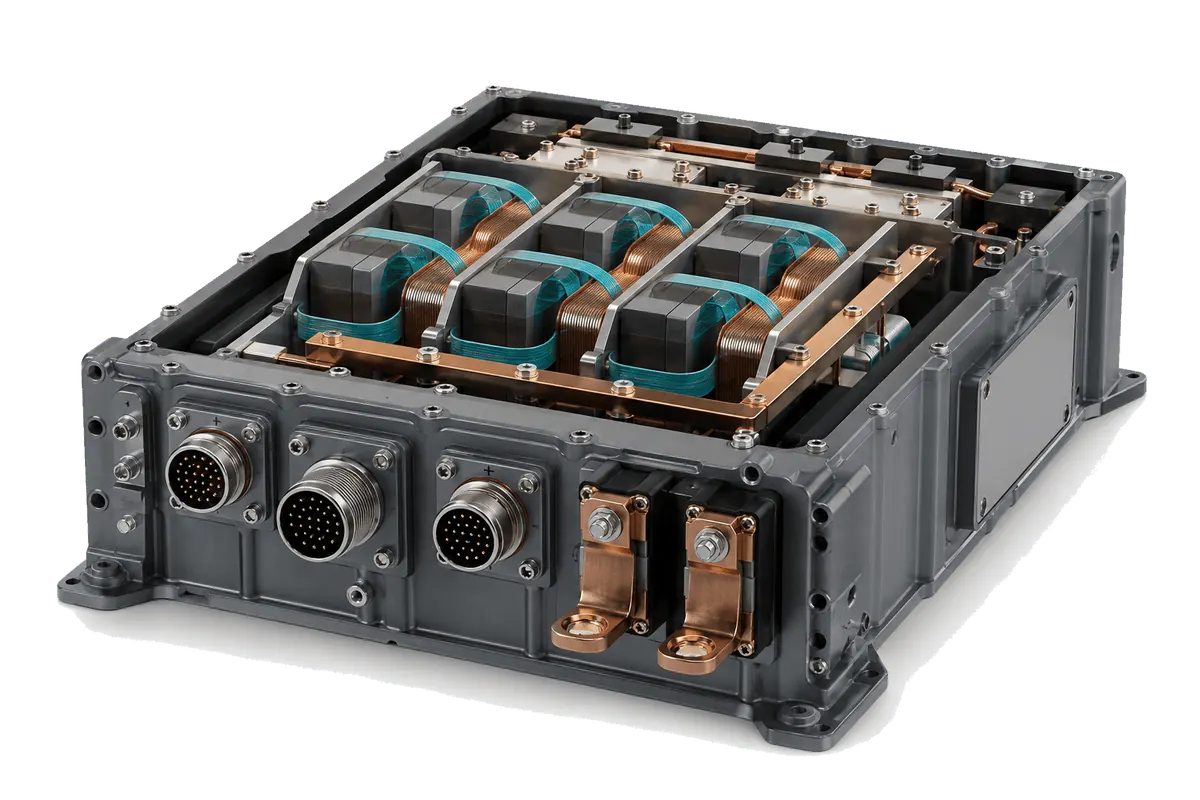
Modern defence platforms are becoming increasingly electrified. From autonomous systems and military vehicles to naval vessels and tactical energy infrastructure, electrical power has become a critical operational capability.
Rather than relying solely on increasingly complex semiconductor switching, DFS places part of the control function directly within the magnetic domain, opening pathways for more resilient, efficient and simplified power architectures.
FluxWorx positions DFS as a platform technology for problems defence engineers already recognise: resilience, thermal management, DC electrification and mission reliability.
Military systems operate under high electrical loads, extreme temperatures, vibration, electromagnetic interference and mission-critical operating conditions. FluxWorx is exploring how active magnetic-domain control can support next-generation defence power systems by reducing complexity, improving control and increasing system resilience.
Architectures that remain controllable under electrical stress, interference and demanding duty cycles.
Lower conversion losses before they become waste heat, cooling demand and reduced endurance.
Support for high-current DC distribution, routing and redundant power pathways.
Fewer stressed stages and simpler control paths as evaluation targets for critical platforms.
These application areas are framed as evaluation pathways, not finished product claims.
Military vehicles, naval platforms and forward operating bases require reliable high-current electrical distribution.
Modern defence platforms increasingly rely on high-voltage DC power. DFS is being developed to support architectures that may:
High-energy DC faults are difficult to manage because DC systems lack natural current zero-crossings. DFS may assist with:
By controlling power earlier within the magnetic system, DFS aims to reduce unnecessary conversion losses before they become:
By shifting selected control functions into the magnetic domain, DFS may support architectures designed for improved resilience in high-EMI environments.
Naval vessels are evolving into highly electrified platforms where propulsion, sensors, communications and mission systems compete for electrical power.
FluxWorx is also investigating applications within switched reluctance motors and advanced electromagnetic actuators.
For decades, improvements in defence power systems have largely come from better semiconductors, better magnetic materials and increasingly sophisticated electronics.
FluxWorx introduces a different approach. Rather than continually adding more switching stages, filtering and cooling, Differential Flux Steering actively controls the magnetic operating state itself.
We are seeking defence organisations, research institutions and industry partners interested in evaluating DFS for mission-specific applications.
No. FluxWorx is seeking defence organisations, research institutions and industry partners to evaluate International Patent Pending Differential Flux Steering for mission-specific power architectures under NDA.
DFS is positioned as a platform technology for problems defence engineers already recognise: resilience, thermal management, DC electrification, fault-energy shaping, EMI-tolerant architecture design and mission reliability.
FluxWorx has lodged an international PCT patent application, completed FEMM finite-element modelling, demonstrated Differential Flux Steering on the bench, and published a commercial whitepaper and technical evaluation programme.
Qualified partners can register interest, review technical materials under NDA, select one mission-relevant use case, and define measured comparison criteria against a reference architecture.
If your organisation is developing next-generation military power systems, tactical energy infrastructure, advanced mobility platforms or resilient electrical architectures, we welcome the opportunity to discuss how Differential Flux Steering could be evaluated within your programmes.