PSU & Power-Shelf Manufacturers
A protected magnetic-control architecture for next-generation AI power shelves
FluxWorx is seeking PSU and power-shelf manufacturers to evaluate International Patent Pending DFS for cooler, denser and lower-stress AI power conversion. DFS is a licensing and development opportunity, not a certified finished product.
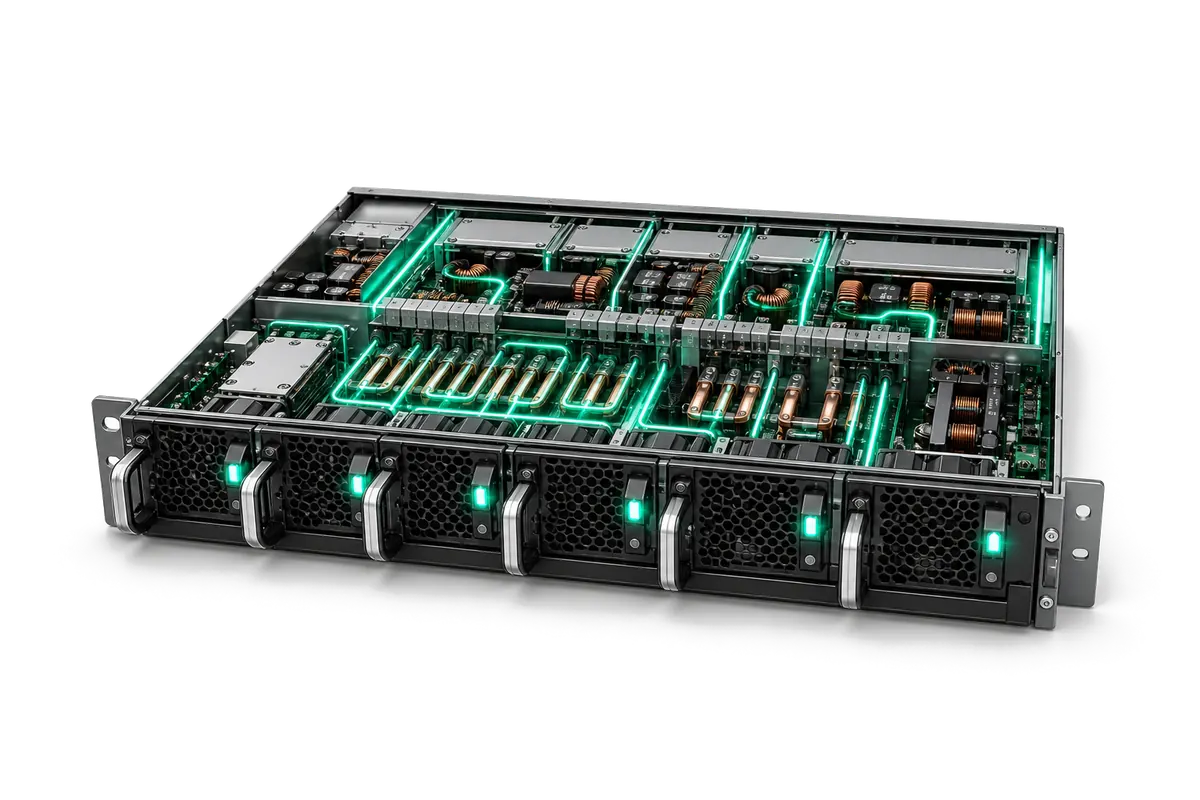
AI rack power is a product-defining battleground
Rack density, fast load transients, cooling limits, grid constraints and direct-DC roadmaps demand architectural differentiation beyond incremental component changes.
Thermal rise
Conversion heat consumes cooling power and limits usable rack density.
Fast load steps
GPU and accelerator demand can challenge bus stability and recovery.
Switching and EMI
Aggressive switching adds device stress, ripple and filtering burden.
Commodity pressure
Marginal efficiency gains can be difficult to defend as a product moat.
A magnetic-domain control layer for PSU design
DFS proposes that a comparatively small steering excitation control a larger working magnetic state. It does not replace good power electronics; it gives semiconductors, controls and magnetics another architecture to evaluate for selected 48/54 V power-shelf topologies.

Validation position: International Patent Pending under an internationally lodged PCT framework, supported by FEMM/FEA modelling and bench proof-of-concept work. Commercial performance remains application-specific and requires independent partner validation.
Projected heat target
50–60% less conversion heat is a projected system-level development target, not a certified result.
Power density
Assess smaller heatsinks, filter burden and tighter magnetic integration.
Transient response
Measure bus stability and recovery under representative AI load steps.
EMI and ripple
Screen whether smoother control can reduce switching and compliance burden.
Product differentiation
Evaluate a protected active-magnetic roadmap and manufacturable geometry.
Priority manufacturer product pathways
These areas offer defined baselines and commercially relevant constraints for structured evaluation.
48/54 V AI power shelves
The immediate target for thermal, density and transient evaluation.
Telecom rectifier derivatives
Mature high-current DC products with strong reliability requirements.
Industrial DC conversion
Dense, robust platforms for automation and factory infrastructure.
Direct-DC facilities
Architectures intended to reduce repeated power-conversion chains.
Evidence-led diligence before commercial claims
Qualified partners can define one use case, compare a reference architecture, and decide whether to stop, extend, co-develop or license.
PSU & Power-Shelf Manufacturers FAQs
Is the projected 50–60% conversion-heat reduction a certified result?
No. It is a projected system-level development target for selected DFS-assisted architectures, not a certified product result or guaranteed efficiency outcome. Actual performance depends on topology, voltage ratio, duty cycle, load profile, switching strategy, materials, cooling design and independent validation.
Where could DFS fit in a PSU manufacturer's roadmap?
The immediate evaluation target is a next-generation 48/54 V AI rack power shelf. Adjacent candidates include telecom rectifiers, industrial DC conversion, VFD platforms and direct-DC facility power.
What validation supports DFS today?
DFS is protected under an internationally lodged PCT patent framework and supported by FEMM/FEA modelling, independent technical review and bench proof-of-concept work. Manufacturer-specific results still require measured, independently reviewable data.
What should a PSU manufacturer evaluate under NDA?
A focused evaluation should compare a selected baseline topology, model or measure thermal rise, assess AI load-step response, screen EMI and ripple, and review controls, BOM, safety, packaging and manufacturability.