Industrial Motor Drives
Magnetic control IP for high-duty industrial motion evaluation
Industrial motors consume a major share of electrical energy across pumps, fans, compressors, conveyors, and process equipment. FluxWorx is seeking expressions of interest from drive OEMs, industrial operators, and technical partners interested in evaluating International Patent Pending Differential Flux Steering technology in future motor drive systems.
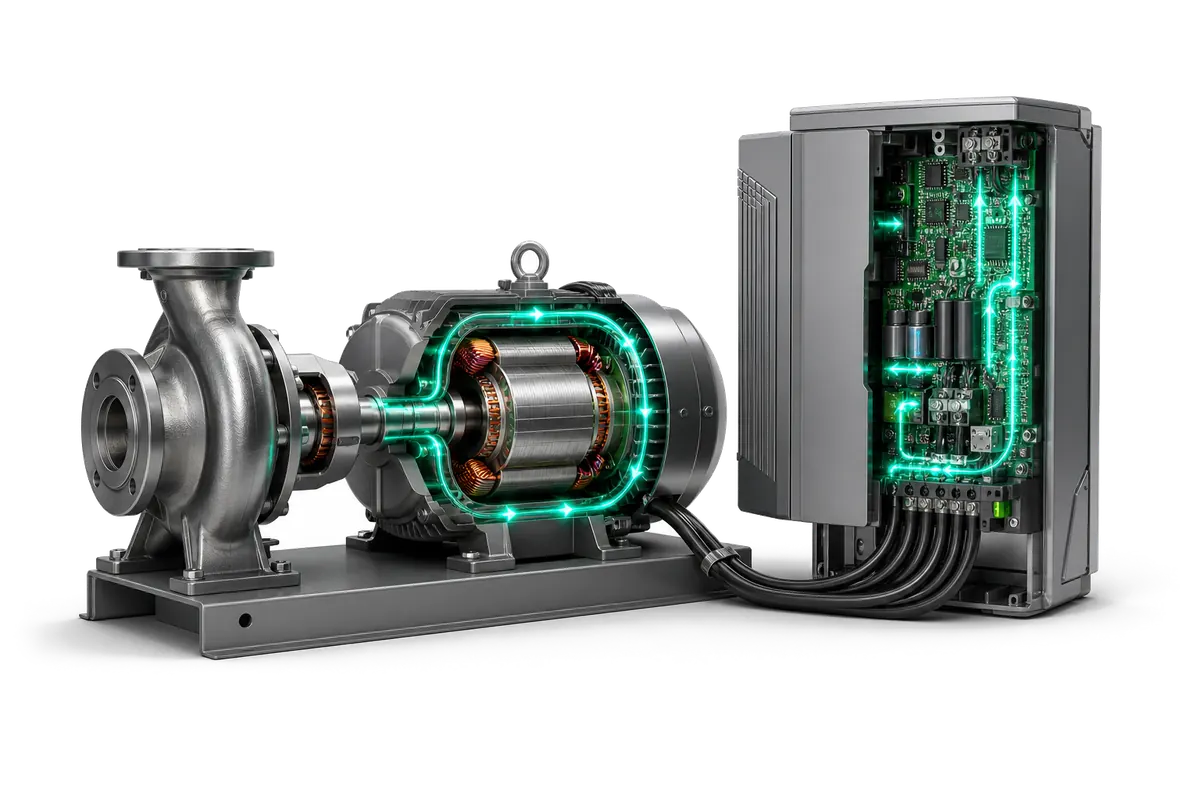
Industrial motion needs efficiency without sacrificing uptime
Factories and infrastructure depend on reliable variable-speed motion. Gains must be proven against harsh duty cycles, retrofit realities, and operational risk.
Energy cost
Small efficiency changes compound across continuous-duty equipment fleets.
Heat and lifetime
Thermal stress affects bearings, insulation, electronics, and maintenance intervals.
Power quality and EMI
Drive switching can create filtering, cabling, and compliance challenges.
Operational risk
Industrial adoption requires evidence, redundancy planning, and low-disruption evaluation.
Differential Flux Steering may be evaluated as a magnetic control layer between the drive electronics and the motor's magnetic system. The target is partner-led assessment of loss, thermal, transient, and control behaviour against a known reference drive.

Energy performance
Efficiency claims would need to be measured across load points and duty cycles.
Thermal behaviour
Potential lifetime benefit depends on lower losses and final packaging.
Retrofit diligence
Adoption requires practical integration with existing motor, drive, and maintenance ecosystems.
Lower drive losses
A/B comparison against a reference drive.
Reduced thermal stress
Temperature rise and duty-cycle review.
Cleaner transients
Startup, braking, and load-step evidence.
Noise and vibration
Measured where motion quality matters.
Robust operation
Harsh-environment and uptime assessment.
Continuous-duty systems with measurable operating costs
Industrial partners can start with controlled applications where baseline performance is well understood and instrumentation is practical.
Pumps and fans
Large installed base with repeatable duty cycles.
Compressors
Thermal and energy savings can carry meaningful operating value.
Conveyors
Stop-start and load variation are useful transient test cases.
Harsh environments
Mining, water, agriculture, and remote infrastructure.
Industrial evaluation pathway
Qualified partners can request technical discussions, International Patent Pending review, modelling material, and a proposed framework for assessing drive fit under NDA.
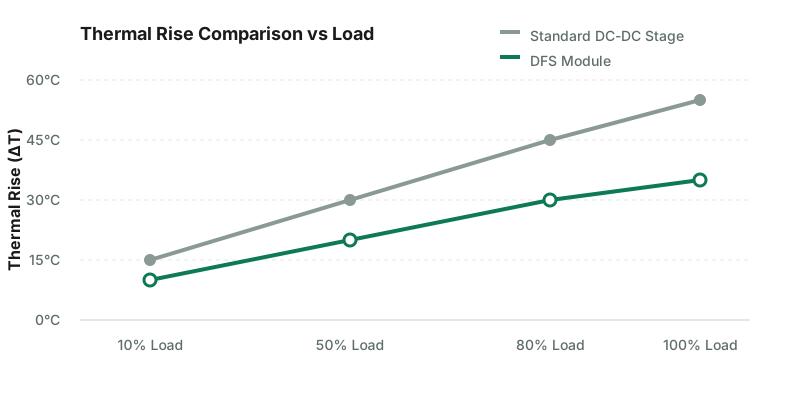
The goal is evidence-led licensing and technical diligence.
Industrial Motor Drives FAQs
Is FluxWorx selling an industrial drive product?
No. FluxWorx is seeking expressions of interest from industrial partners that may wish to evaluate its International Patent Pending magnetic control IP for future drive applications.
Which industrial systems could be evaluated?
Potential evaluation areas include pumps, fans, compressors, conveyors, harsh-environment motion, and variable-speed drive systems. Any benefits require partner-specific testing.
Could Differential Flux Steering improve industrial drive efficiency?
Efficiency is a target evaluation area. FluxWorx seeks partner-led comparison against known motor and drive baselines across load points, duty cycles, thermal conditions, and control settings.
How would an industrial partner evaluate FluxWorx magnetic control IP?
A qualified partner can review the International Patent Pending materials under NDA, define a reference drive or motor system, and compare efficiency, temperature rise, transient behaviour, EMI notes, and integration requirements.