Robotics & Actuation
Cooler, smoother, lower-energy magnetic force control
FluxWorx invites robotics OEMs and actuator manufacturers to evaluate International Patent Pending DFS for directing, balancing or releasing useful magnetic force with lower continuous electrical burden.
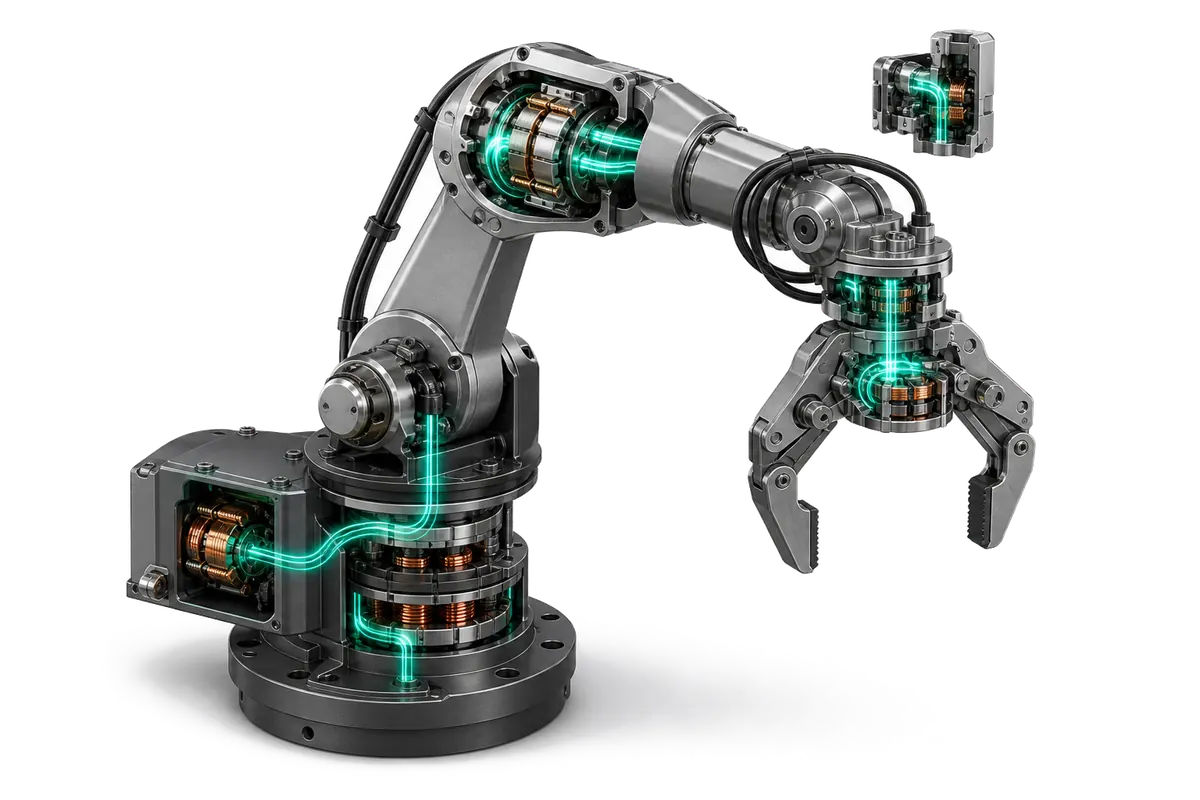
The next robotics ceiling is physical actuation
Creating more electromagnetic force usually means more coil current, I²R loss, heat, larger drivers, heavier thermal design and shorter battery-powered operating windows.
High hold current
Continuous current drains batteries and heats compact actuator packages.
Heat near people
Cobots, prosthetics and wearables have strict temperature constraints.
Ripple and harsh engagement
Noise, shock and low-speed behaviour reduce control quality.
Actuator bulk and wear
Mechanical locks, brakes and thermal hardware add size and maintenance.
Control useful force, not only coil current
DFS uses a steering or control excitation to influence a larger magnetic bias field. The bias field can supply the force resource while steering controls where it is useful, creating a pathway to modulated engagement, holding and release.

Validation position: International Patent Pending under an internationally lodged PCT framework, supported by FEMM/FEA modelling and bench proof-of-concept work. Commercial performance remains application-specific and requires independent partner validation.
Force-per-watt opportunity
Test whether useful force can be controlled with lower continuous current.
Cooler hold states
Measure coil temperature, driver load and battery impact.
Smoother force control
Evaluate engagement ramps, release time, ripple and acoustic behaviour.
Compact packaging
Assess driver, cooling and mechanical-locking requirements.
Protected product path
Explore field-of-use licensing for differentiated magnetic devices.
Priority robotics and actuator applications
These areas offer defined baselines and commercially relevant constraints for structured evaluation.
Latches and tool changers
Strong hold, low-energy release and fail-safe switching opportunities.
Grippers and end effectors
Soft grip onset, adjustable hold and rapid low-heat release.
Magnetic brakes and clutches
Proportional torque engagement for joints, cobots and haptics.
Valves and reluctance actuators
Latching, proportional flow and smoother specialised joints.
Evidence-led diligence before commercial claims
Qualified partners can define one use case, compare a reference architecture, and decide whether to stop, extend, co-develop or license.
Robotics & Actuation FAQs
How could DFS reduce actuator holding power?
DFS proposes using a magnetic bias field as the force resource while a smaller steering excitation controls engagement, balance or release. Any holding-power reduction must be measured in the target device.
Which robotics applications are the best first targets?
Strong candidates include magnetic latches and tool changers, low-heat grippers, proportional brakes and clutches, latching valves, solenoid replacements, reluctance joints and wearable joint locks.
Is DFS performance proven in production robotics?
No. DFS has an internationally lodged PCT patent framework, FEMM/FEA modelling and bench proof-of-concept testing, but application-specific force, heat, duty-cycle, safety and lifetime outcomes require independent validation.
How can a robotics partner evaluate DFS?
A qualified partner can review technical material under NDA, select one product limited by hold current, heat, bulk, release time or torque smoothness, scope prototype geometry, and define measured comparison criteria.