Grid & Electrification Infrastructure
Active magnetic-domain control for high-power DC infrastructure
FluxWorx is seeking grid, storage, charging and infrastructure partners to evaluate International Patent Pending Dynamic Flux Steering (DFS) as an active magnetic control layer for future high-power conversion systems.
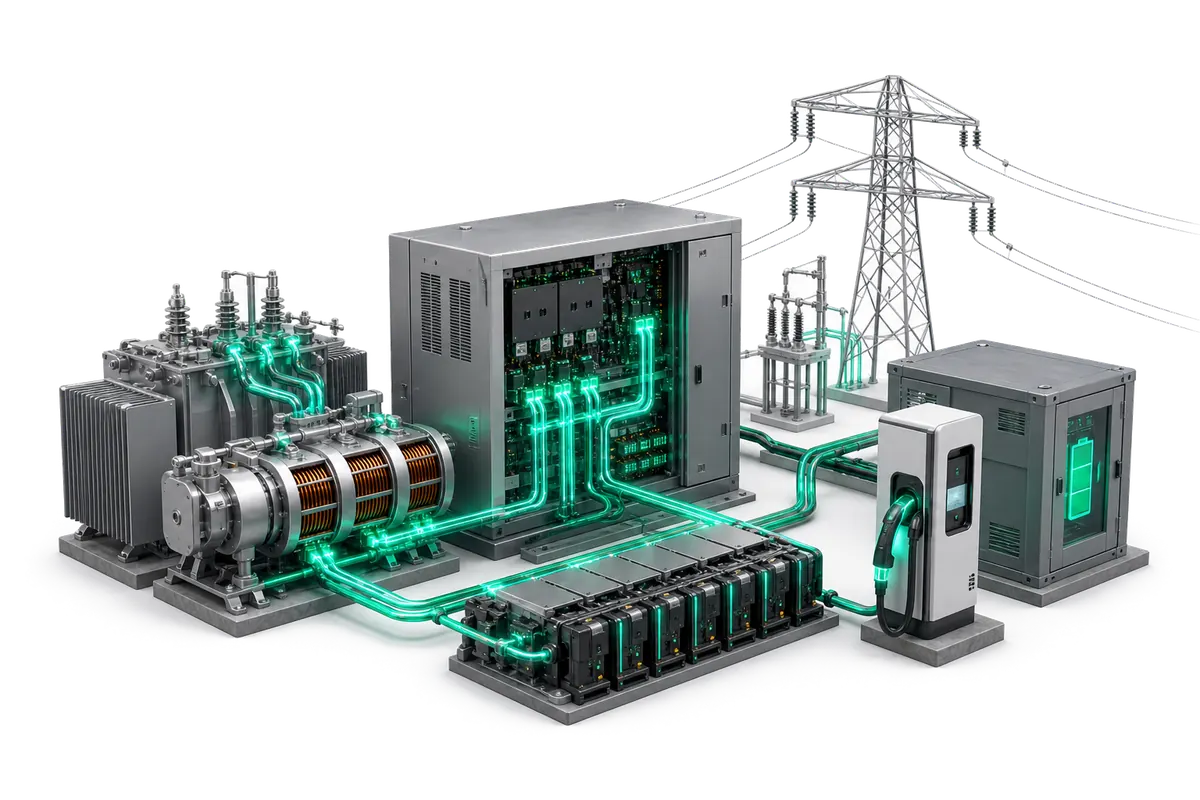
Electrification is becoming a converter-density challenge
Repeated rectification, inversion, DC-DC conversion, filtering, protection and cooling add loss, heat, EMI exposure, footprint and reliability burden.
Converter heat
Thermal derating limits useful power in chargers, storage stations and harsh-site cabinets.
Bidirectional complexity
Batteries, EVs and microgrids increasingly require stable two-way power flow.
EMI and power quality
High-power switching increases filtering, shielding, harmonic and compliance costs.
Expansion constraints
More useful power must fit existing grid connections, enclosures, cooling and land.
DFS active-magnetic infrastructure opportunity
DFS proposes that a smaller steering excitation influence a larger magnetic flux distribution, making the magnetic structure an active participant in power regulation. It can be evaluated as a DC-DC, bidirectional, buffer or smoothing stage—not as a replacement for all power electronics.

Validation position: International Patent Pending under an internationally lodged PCT framework, supported by FEMM/FEA modelling and bench proof-of-concept work. Commercial performance remains application-specific and requires independent partner validation.
Lower thermal burden
Assess converter loss, cabinet temperature and derating against a defined baseline.
Reduced switching severity
Evaluate device stress, ripple and transient behaviour in the selected topology.
Smaller filtering burden
Measure EMI and power quality before drawing packaging or compliance conclusions.
Higher power density
Test whether cooling, filtering and enclosure overhead can be reduced.
Rugged operation
Review reliability margin under heat, vibration, dust and long-cable conditions.
Priority grid and electrification applications
These areas offer defined baselines and commercially relevant constraints for structured evaluation.
Battery energy storage
Bidirectional conversion, DC-bus stability and charge/discharge transients.
EV fast charging
High-current DC conversion, thermal load and renewable or battery integration.
Renewable DC aggregation
Control between variable sources, storage and grid-interface stages.
Microgrids and industrial DC
Rugged source/load balancing, surge response and constrained cabinets.
Evidence-led diligence before commercial claims
Qualified partners can define one use case, compare a reference architecture, and decide whether to stop, extend, co-develop or license.
Grid & Electrification Infrastructure FAQs
Is DFS a replacement for all grid power electronics?
No. DFS is proposed as an active magnetic-domain control layer for targeted converter, buffer, smoothing or bidirectional interfaces. Its fit must be evaluated within a complete partner architecture.
Which grid applications are priorities for DFS evaluation?
Priority areas include battery energy storage, EV fast charging, renewable DC aggregation, microgrids, industrial DC buses, hydrogen electrolysers, and rail, marine or mining electrification.
What evidence supports the grid electrification concept?
DFS is covered by an internationally lodged PCT patent framework and supported by FEMM/FEA modelling and bench proof-of-concept work. Application-specific grid outcomes have not yet been independently validated.
How would an infrastructure partner begin?
A qualified partner can review the International Patent Pending materials under NDA, select a defined use case, establish thermal, EMI, ripple, transient and power-density baselines, and plan simulation and bench comparison.