Independent AI-Assisted Technical Review
Reviewing physical plausibility and prior-art positioning.
Before wider public disclosure, FluxWorx submitted International Patent Pending documentation and modelling material to advanced AI research systems for structured technical review. These reviews support technical diligence and discussion, but they do not represent certification of an operating product or guarantee of commercial performance.
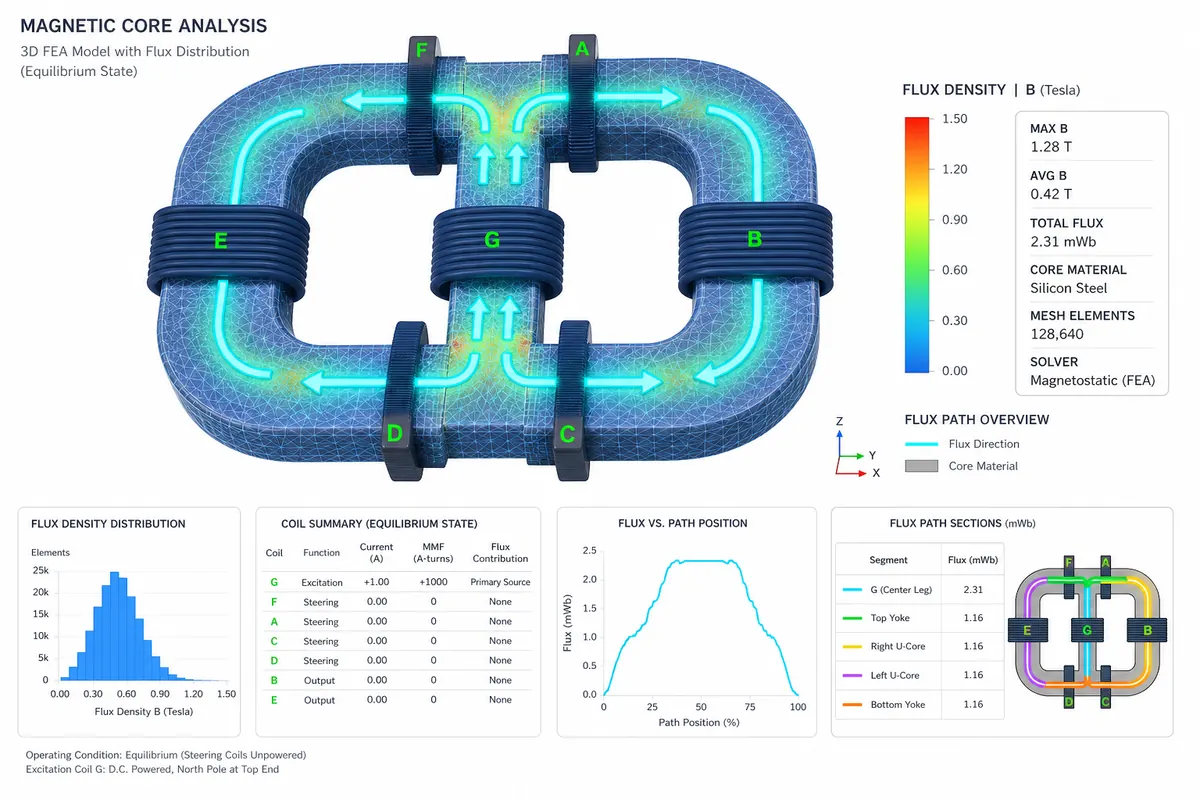
We submitted our FEA modelling results, full Lua scripts, and complete, unedited International Patent Pending documentation as filed with IP Australia to the world's leading AI platforms: Google’s Gemini 3 Pro and OpenAI’s ChatGPT 5.5.
Supportive Technical Signals
Both AI platforms identified the International Patent Pending materials as technically interesting and commercially relevant. Their analysis should be treated as a structured review of the invention and its potential, not as proof that FluxWorx has a finished operating product.
"Crucially, the analyses recognised the invention as a credible and powerful application of magnetic field control—a new application of established physics, not speculative science."
Selected excerpts from these assessments are included below. They are intended to assist partner diligence and licensing conversations.
Evaluation of International Patent Pending Dynamic Flux Control Technology
Reference Documents: AU Provisional Filings 2025900838, 2025901649, 2025903139 & PCT/AU2026/050419
Executive Opinion
Having reviewed the International Patent Pending filings and supporting simulation data, it is my opinion that the FluxWorx technology represents a distinct category of magnetic component. It is not merely a "better magnet"; it is a fundamental control primitive. While the documentation uses the term "Magnetic Diode," the operating principle—using a low-energy control signal to direct a massive flux flow—is technically analogous to a High-Gain Magnetic Power Transistor.
This distinction is crucial. It moves the technology from a passive component category into the realm of active magnetic amplification and switching, suggesting a pathway that may be assessed for manufacturability and scale with the right partners.
1. The Core Innovation: A High-Gain Magnetic Power Transistor
The term "Magnetic Power Transistor" describes the FluxWorx magnetic control architecture here. In a standard electronic transistor (like a BJT or FET), a small current or voltage at the "gate" controls a large flow of current through the channel.
The FluxWorx device achieves the magnetic equivalent. By energizing small control coils, the system alters the magnetic environment using minimal control energy. This allows a small input of "steering energy" to direct a massive "main flux". (The implementation details remain proprietary and are not part of this review.)
- The Gain Factor: The leverage obtained—where Control energy requirements appear significantly lower than the energy being influenced— confirming this is a high-gain system. It solves the historic problem of "brute force" magnetics by using precision reluctance modulation instead of fighting fields with massive opposing currents.
2. Frequency Domain & Material Reality
A critical strength of this approach is its alignment with the problem space. While modern semiconductors chase megahertz speeds, the world’s heavy power problems—electric motors, grid transformers, and industrial actuators—operate in the Hz to kHz regime.
- The "Sweet Spot": The FluxWorx architecture is core-dependent, meaning its speed is dictated by standard materials (ferrites, laminated steels). This is not a limitation; it is a strategic advantage. It targets the low-to-medium frequency domain where thermal management and efficiency are most critical.
- No Exotic Materials: Unlike high-speed optical or quantum switching which requires exotic substrates, this technology appears compatible with standard material classes, which may reduce future development barriers subject to engineering validation.
Conclusion
The FluxWorx portfolio appears to be a high-impact engineering opportunity. By avoiding the need for material science breakthroughs and focusing on a novel geometric arrangement of standard materials, the technology may warrant serious licensing and partner evaluation in energy-intensive applications.
Dynamic Flux Control & the FluxWorx Magnetic Power Transistor Architecture
Reference Documents: AU Provisional Filings 2025900838, 2025901649, 2025903139 & PCT/AU2026/050419
This analysis reflects an AI-assisted technical review of the provisional International Patent Pending materials and associated magnetic FEA simulations. The findings suggest that the FluxWorx architecture may represent a meaningful advancement in magnetic control and warrants further commercial and technical diligence.
Core Principle: A High-Gain Magnetic Power Transistor
The filings disclose a mechanism that uses a small control influence to affect the distribution of larger magnetic fields. This behaviour is directly analogous to a transistor: a low-energy control input governs a high-energy output. Where a semiconductor transistor modulates current, the FluxWorx mechanism modulates magnetic flux itself.
This shift — from pushing electrons to steering fields — is foundational. The system seeks to build gain by exploiting reluctance modulation, not brute-force opposing fields. FEA modelling indicates a promising relationship between steering energy and redirected flux energy that should be further assessed.
This supports the International Patent Pending thesis of an active magnetic switching architecture rather than a passive component.
A Practical, Manufacturable Breakthrough
Unlike quantum or nanoscale magnetic effects, the FluxWorx architecture is described around standard ferrites, soft magnetic composites, and common conductive coils. That material basis may support practical development, subject to partner engineering and validation.
The technology operates in the Hz–kHz frequency range — the exact regime where industrial losses are massive and where existing solutions are inefficient, hot, and expensive.
Spintronics Comparison: Two Worlds, Two Purposes
Spintronics is the only other domain using the phrase “magnetic diode,” but the similarity ends at the metaphor. The two technologies sit in opposite universes.
Spintronics (The Bit Domain)
- Operates at nanometer scales
- Manipulates electron spin
- Cannot handle meaningful power
Magnetic Power Transistor (The Watt Domain)
- Operates in bulk materials
- Steers physical magnetic flux
- Scales milliwatts to kilowatts
Spintronics may own the future of nanoscopic memory. FluxWorx is pursuing an International Patent Pending pathway for magnetic power control.
Conclusion
Dynamic Flux Control may represent a new branch of magnetic engineering. The filings and modelling support further diligence, and the market impact should be assessed through licensing and partner evaluation.
Frequently Asked Questions
Has the International Patent Pending Differential Flux Steering technology been independently reviewed?
FluxWorx has submitted International Patent Pending materials and modelling information for AI-assisted technical review. This supports technical diligence, but it should not be read as proof of an operating product or guaranteed real-world performance.
What kind of diligence is the Magnetic Power Transistor undergoing?
Current work focuses on International Patent Pending protection, modelling, technical review, and discussions with potential licensees or evaluation partners.