Industrial Power Conversion
Cooler, quieter and denser industrial converter evaluation
FluxWorx invites converter manufacturers and industrial power teams to evaluate International Patent Pending DFS as an active magnetic-control layer for reducing heat, EMI, switching stress and enclosure burden.
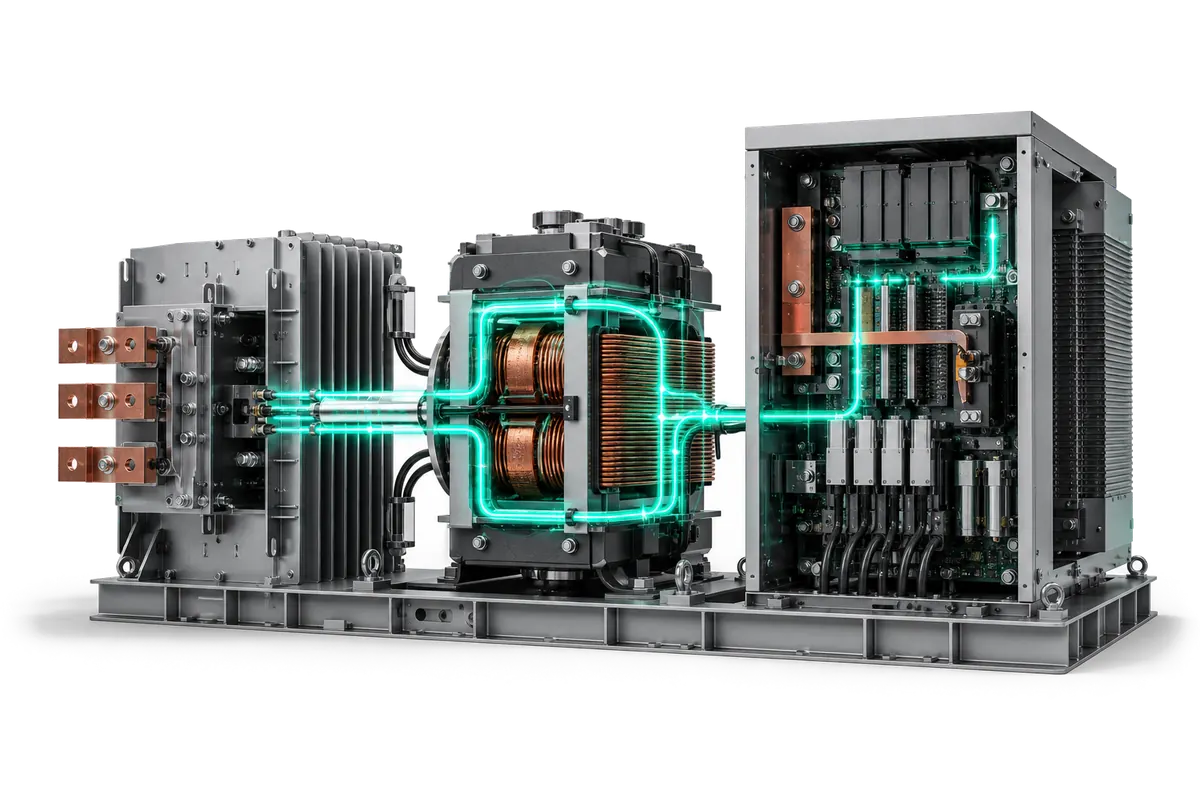
Industrial converters are being pushed harder
Electrification, automation, high-power DC buses and harsh sites amplify switching loss, ringing, thermal stress, filtering bulk and reliability pressure.
Hard-switching stress
Ringing, overshoot and junction heating can accelerate device ageing.
Passive magnetic limits
Transformers, chokes and reactors usually act only after switching events.
Filtering and cooling bulk
Heatsinks, snubbers, shielding and filters consume cabinet volume.
Harsh-site derating
Heat, dust, vibration, poor power quality and long cables reduce margin.
Move part of control into the magnetic domain
DFS adds magnetic-domain control alongside semiconductors, passive magnetics and digital control. A partner can test whether an active magnetic assembly reduces electrical severity at the source while preserving required regulation, safety and reliability.

Validation position: International Patent Pending under an internationally lodged PCT framework, supported by FEMM/FEA modelling and bench proof-of-concept work. Commercial performance remains application-specific and requires independent partner validation.
Thermal margin
Compare converter loss and temperature rise under representative duty cycles.
EMI reduction
Screen conducted noise, ripple and potential filter or shielding changes.
Device stress
Measure switching waveform severity, overshoot and transient behaviour.
Power density
Assess heatsink, filter and enclosure reduction without assuming a result.
Reliability headroom
Evaluate operation under realistic environmental and load conditions.
Priority industrial converter applications
These areas offer defined baselines and commercially relevant constraints for structured evaluation.
Motor drives and VFDs
Output conditioning, cable EMI, dV/dt stress and magnetic buffering.
Industrial DC buses
Controlled transfer among 400 V to 1500 V buses and regulated outputs.
Storage, UPS and microgrids
Bidirectional interfaces, surge management and load-step response.
Process and rugged power
Welding, electrolysis, mining, marine, rail and remote systems.
Evidence-led diligence before commercial claims
Qualified partners can define one use case, compare a reference architecture, and decide whether to stop, extend, co-develop or license.
Industrial Power Conversion FAQs
What is the industrial power conversion opportunity for DFS?
DFS may allow part of a converter's regulation burden to move into active magnetic-domain control. Potential value areas include lower switching severity, heat, EMI, filtering burden and enclosure volume, all subject to partner testing.
Which industrial converters could be evaluated first?
Candidates include motor drives and VFDs, high-voltage industrial DC-DC stages, battery storage and UPS interfaces, EV charging, welders, electrolysers, and rugged mining, marine or rail power systems.
Is DFS already validated as a commercial industrial converter?
No. DFS has an internationally lodged PCT patent framework, FEMM/FEA modelling and bench proof-of-concept support, but product-specific performance, safety, manufacturability and reliability require independent partner validation.
What should an industrial evaluation measure?
A useful comparison should measure converter loss, thermal rise, device stress, switching-waveform severity, EMI, filter and heatsink requirements, load-step response, power density and reliability margin.